


Every day there’s another Chinese car in Sri Lanka. However, contrary to popular belief, these aren’t mushroom outfits. XPENG is arguably one of the newer Chinese automakers, but it’s still over a decade old. Founded by two senior executives formerly of GAC Group, XPENG enjoys a strong partnership (as well as some investment) from Volkswagen Group. Furthermore, the literature provided to me by Evolution Auto (authorized distributor for XPENG in Sri Lanka) informs that Foxconn, IDG Capital and Alibaba have made investments in the brand too.
The first XPENG model to hit our shores is the XPENG G6, a compact luxury crossover. Introduced in 2023, it’s got an interesting rear-wheel drive platform and looks quite smart on our roads. In fact, during our test drive, the vehicle garnered plenty of attention from curious onlookers. We’re also thankful to Evolution Auto for giving us the first test drive of the G6, so that we can bring it to you right here.
Exterior
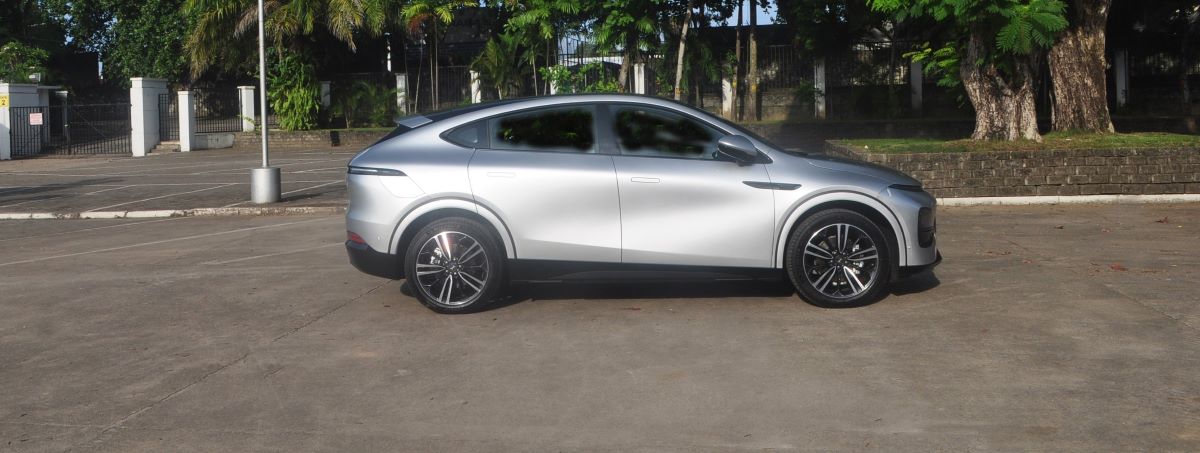
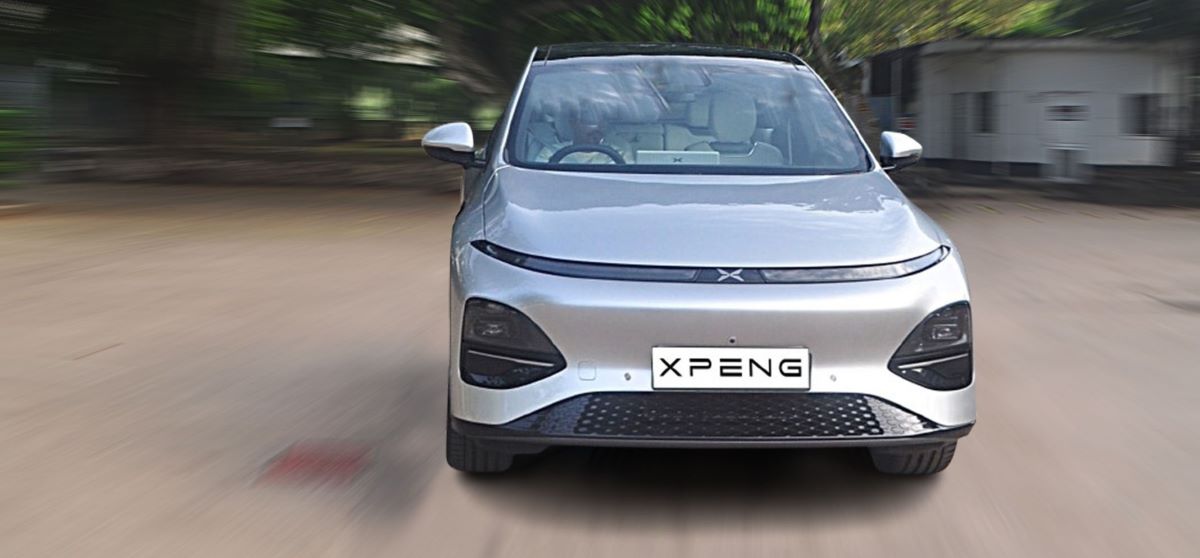
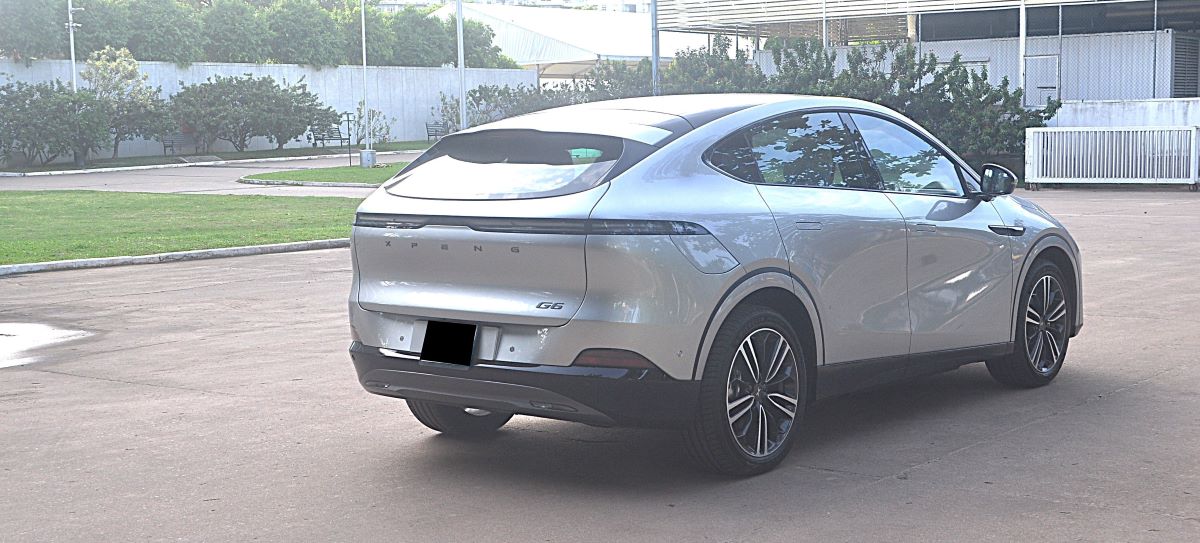
The XPENG G6 features a “Robot Face” design and a
streamlined body shape, as per the brochure. We’ve got some nice slimline LED
daytime running lamps while the LED headlamps are located lower down, as is
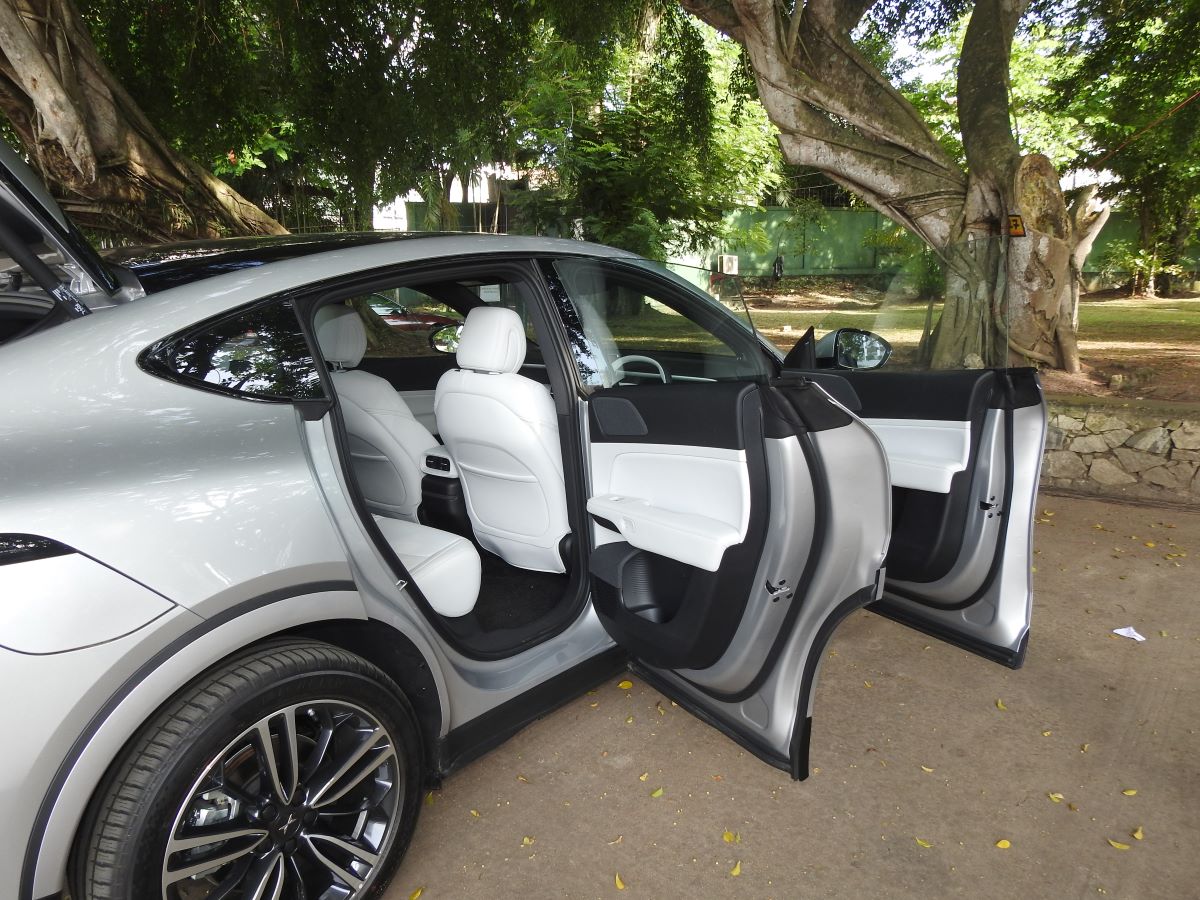
becoming a design theme nowadays. Frameless doors are another neat feature, and
I must remind you, dear reader, that when opening or closing a frameless door
on any vehicle, you must not grab or push it by the glass. At the rear, we’ve
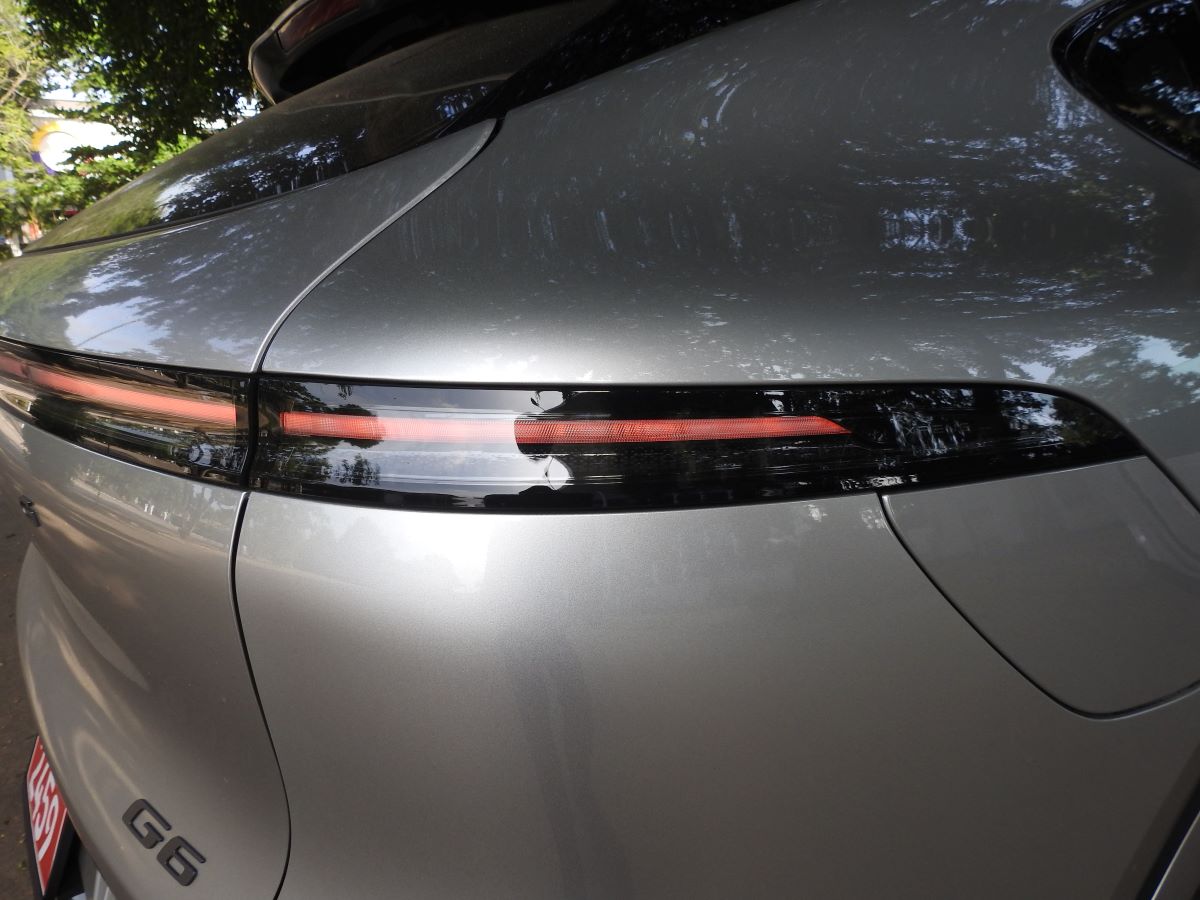
got LED taillamps, daringly referred to in the brochure as Lightsaber LED taillights,
and a high-set profile. Our test G6 didn’t have roof rails but we note that
they can be installed if needed. We also like the panoramic glass roof that
really lights up the white interior of our test vehicle.
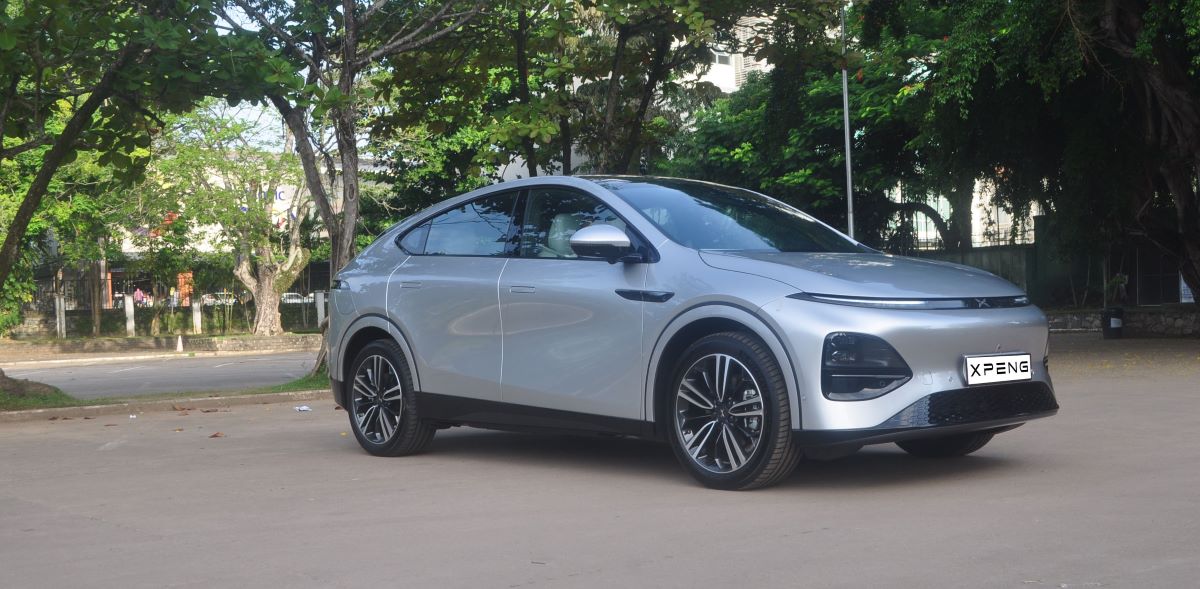
Overall, the XPENG G6 cuts a sleek stance, aided by its 10-spoke polished black alloy wheels and Silver Frost paintwork. There are three other colours available, namely Midnight Black, Graphite Gray and Acrtic White. These will cater to most users, but I did tell Evolution Auto that I felt XPENG should offer some non-monochrome shades too. Heck, a bright orange, a smooth mid-blue, a nice metallic green or even a strong red would be nice. Some people we showed the vehicle to commented as such. They also remarked on the recognizable design cues from other vehicles, notably some German machines and a certain prolific American manufacturer in silhouette. But XPENG hasn’t gone down the carbon copy route. They’ve simply drawn inspiration and adapted it.
Mech & Tech
The XPENG G6 that Evolution Auto brings down for our
market is a 190-kilowatt (255 horsepower) rear-wheel drive variant. So you’ve
got a single motor powering the rear axle. Researching the model online, I see
that dual motor, all-wheel drive variants with up to 358 kilowatts (457
horsepower) are available, offering tasty 0-100km/h times of 3.9 seconds.
However, our test vehicle isn’t too shabby, with a rated 0-100km/h time of 6.6
seconds and 325lb-ft of torque. The top speed is electronically capped at
200km/h. Remember that electric motors make maximum torque from zero rpm, which
is why EVs leap off the line so smartly. As for the battery, our test vehicle
has a 66-kilowatt-hour battery pack with ten dimensions of safety according to
the brochure.
Being an EV there’s no gearbox to speak of obviously, as the vehicle is direct drive. The front suspension is double wishbone while the rear uses multi-link independent suspension as expected for a vehicle with a luxury value proposition. Front and rear stabilizer bars are included too. Braking is via discs on all wheels, aided by multiple modes of regeneration. The steering system uses an electrically assisted rack.
Driving Experience
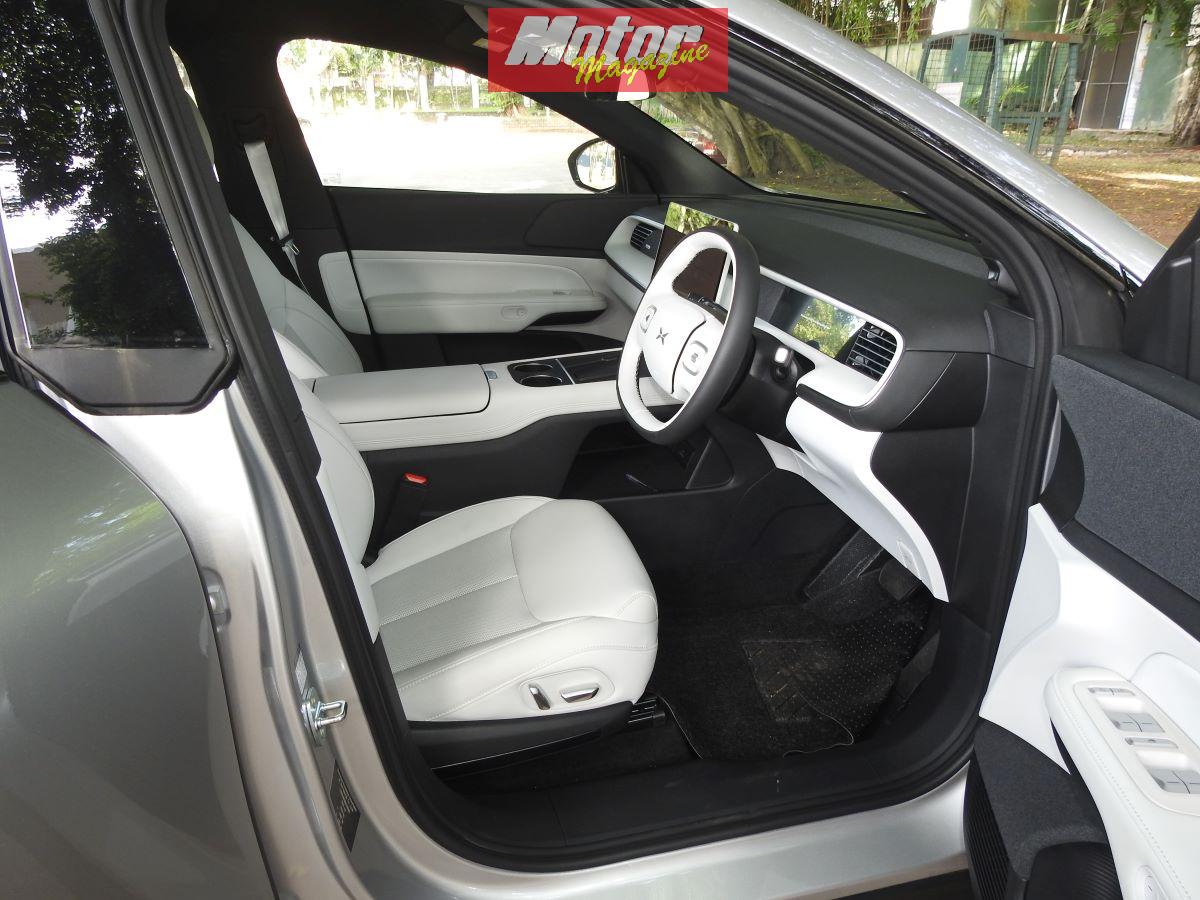
The XPENG G6 is one of those “walk up, get in and
drive” cars. Approach the car with the key fob in hand or press the unlock
button and the now-ubiquitous pop-out door handles emerge. Open the frameless
door, enter the driver’s seat and…what’s this? You might think that the
previous occupant was very tall because the seat has motored right back.
Actually, this is the comfort access feature that also works for the powered
front passenger seat. The car’s systems move the seat right back and recline
the backrest a tad to make entry and exit easy. Once you’re in, simply close
the door and the seat will return to its previous position. There’s no Start or
Power button either, the G6 is switched on and ready to go.
Select D via the column-mounted gear shifter and the electronic parking brake automatically disengages. If you’re on an incline, the hill hold function will be doing its thing. Give the throttle a stroke and away you go. First impressions are typical EV, with that smooth rush of power, lack of noise or vibration, and stepless gaining of speed. However, you don’t need to venture far into the throttle pedal’s travel to know that this has more than the typical 100 kilowatts that many EVs in Sri Lanka develop due to import taxation duties on EVs penalizing every kilowatt of motor power. That’s a topic worthy of a lengthy rant in another article so let’s return to the G6 review, pronto.
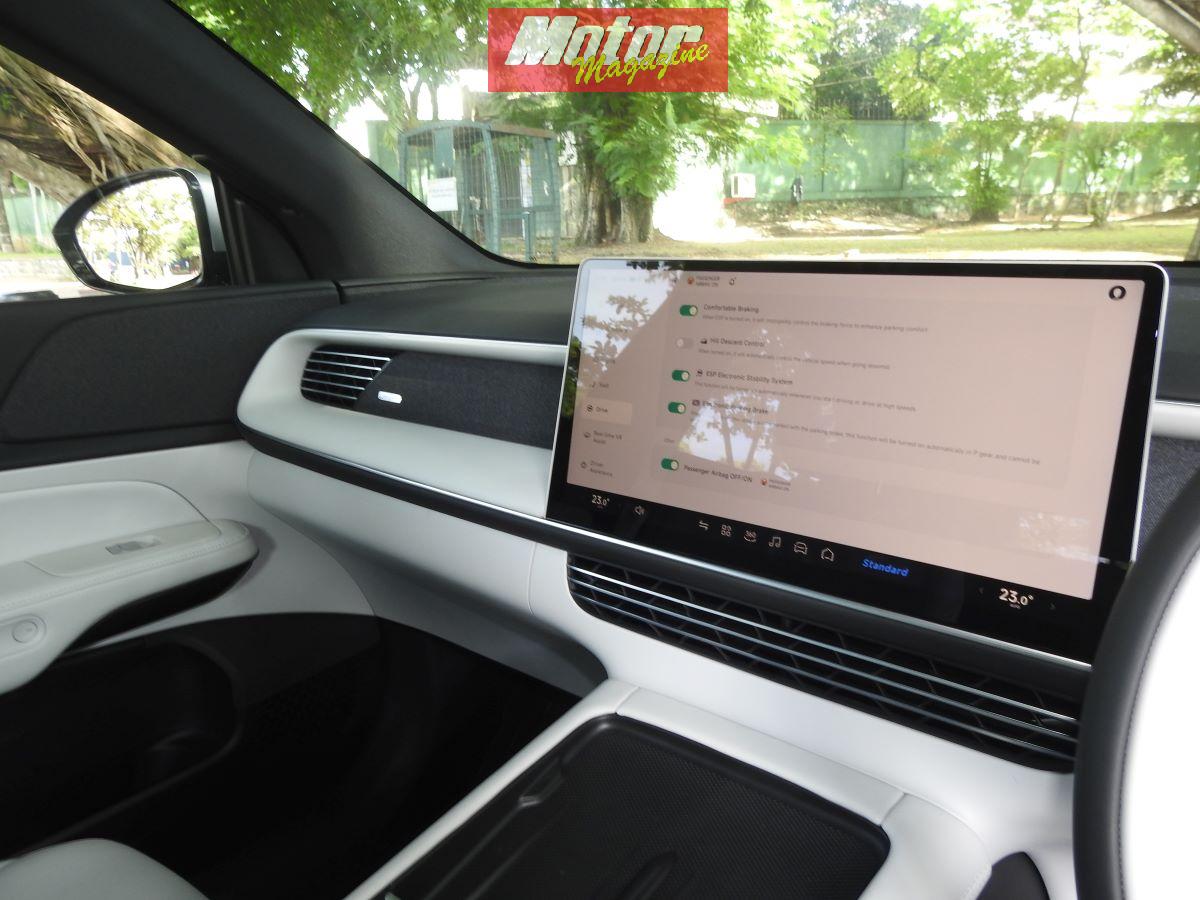
We’ve got four pre-set driving modes, namely Comfort, Standard, Sport and Launch. Then, you’ve also got the ability to adjust energy recuperation between Low, Mid, High and X-Pedal which is basically one-pedal driving. For those who aren’t familiar with this term, it dials up the regeneration to such a high level that simply backing off the throttle pedal can bring you to a smooth halt. So, you can easily find your ‘sweet spot’ when driving sedately and sanely in the G6. For me, that was Comfort or Sport mode with recuperation set to Mid, as I’m not a big one-pedal driving fan.
In Sport, you can feel things tighten a smidge. The throttle response is notably sharper (it’s most sedate in Comfort but you’ve still got power if you press more), and the steering firms up too. We don’t have adaptive suspension here, but some spirited corners show me that the G6 is set up for pretty enthusiastic driving without compromising much on ride comfort. The ride also has that quality of amply damping and nicely rounding off harsh edges – such as when you drive over a badly-placed manhole cover or drop into a rough pothole. Another point I must mention is that there’s a Comfort Braking Mode which claims to optimize the use and blending of the regenerative and disk brakes. I kept it switched on more or less throughout my test drive and found it made brake pedal modulation very easy, even when hauling the G6 down from higher speeds.
Launch is the most entertaining mode. When you select
it, a warning actually flashes up on the screen telling you that the car will
dial back its stability and traction control systems and to be aware that this
mode is meant for track or closed course driving. So I had to try it, naturally.
First off, I selected it on a straight road, and tried a proper launch – that
is, left foot on brake, and quickly lift off brake as you use your right foot
to give full throttle. What followed was very pleasing, with the G6 rocketing
off in a smooth fashion, easily making all of us believe its 6.6-second
0-100km/h time. Mind you, this was with four adults on board.
And yes, launch does dial down the traction control. While making a three-point turn on a road with loose sand atop the tarmac, I gave it a good dose of throttle when taking off and felt the rear wag a bit. It was rather nice for me, perhaps less so for my passengers. But what struck me as impressive was that the vehicle didn’t just rocket off in a vulgar fashion, delivering everyone a strong gut punch. After all, this isn’t an all-out supercar, rather a compact luxury SUV. So, it had a more “iron fist in velvet glove” feel. This was even apparent to me and Mahen when we were shooting video about the rear seat ride while Editor Nimal in the driver’s seat was giving it the beans in launch mode no less.
Living With the XPENG G6
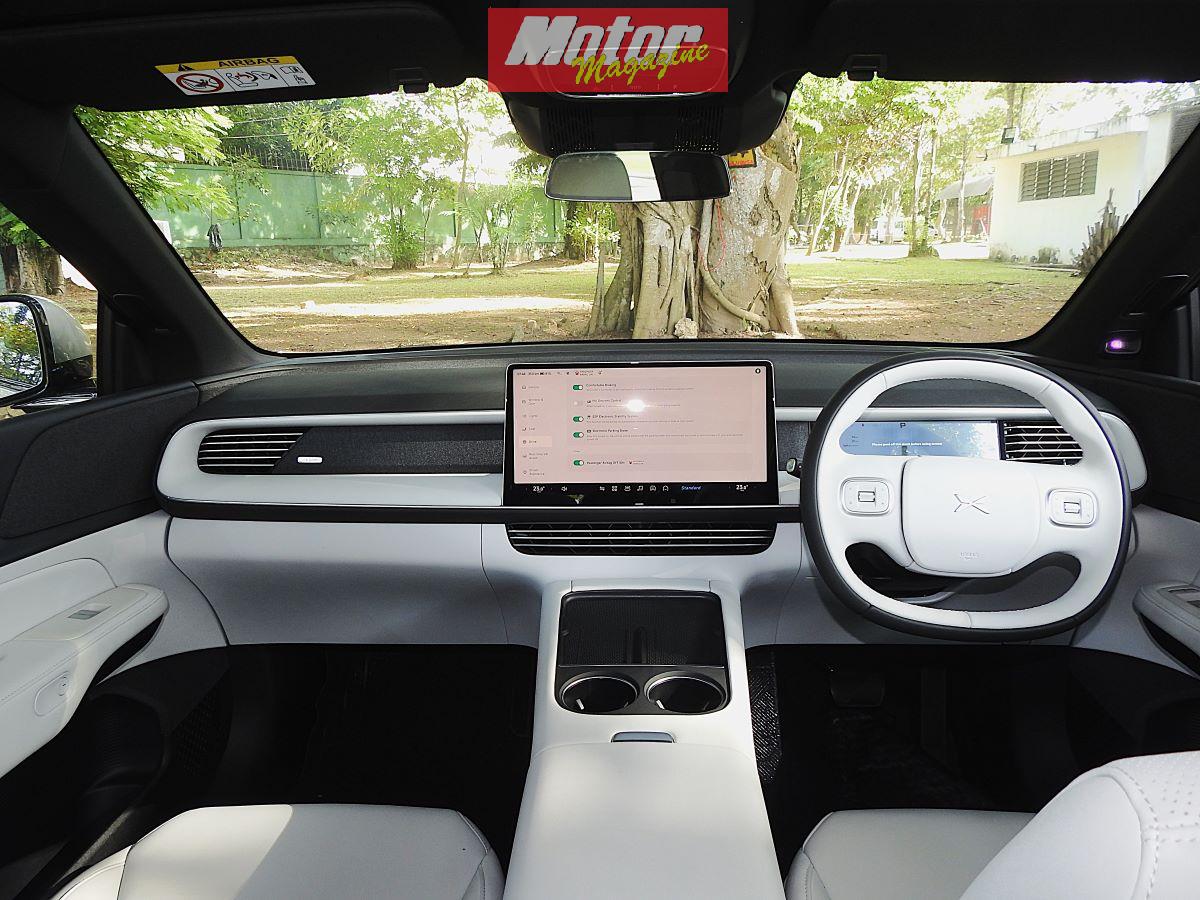
Our test vehicle comes in a very clean and sleek white
theme for its relatively simplistic interior. My first question to Ashan
Wickramasinghe from Evolution Auto regarding this choice of hue was “won’t this
get dirty very easily”? He told me that when our test vehicle arrived from the
Port, it even had pen marks on the interior – yet none of these are visible
now. A simple wipe-down with Wurth Cockpit Cleaner was enough to do the trick.
So yes, it looks like XPENG have considered the maintenance aspect of a
predominantly white interior and constructed it as such. But if you’re still
unconvinced, there’s a black interior available too, which will be better for
family or fleet use.
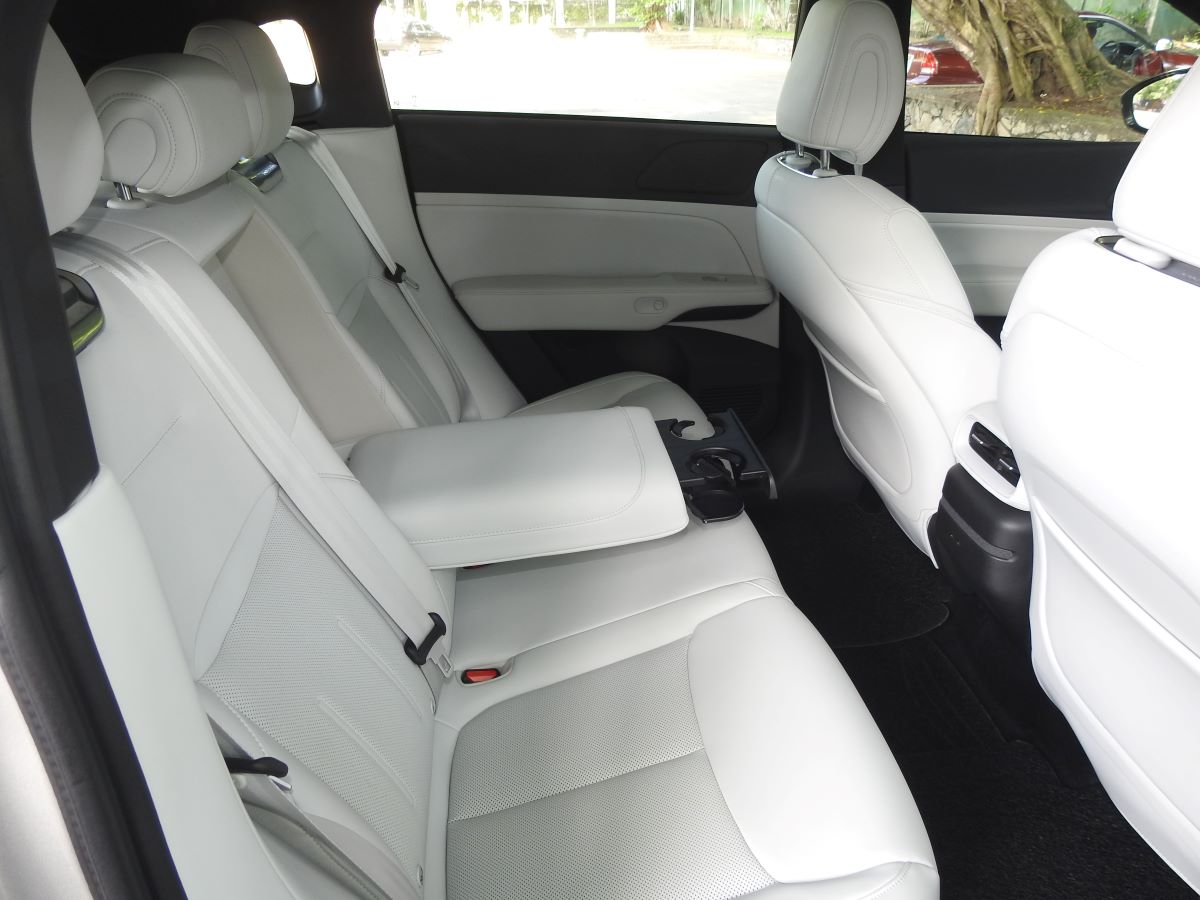
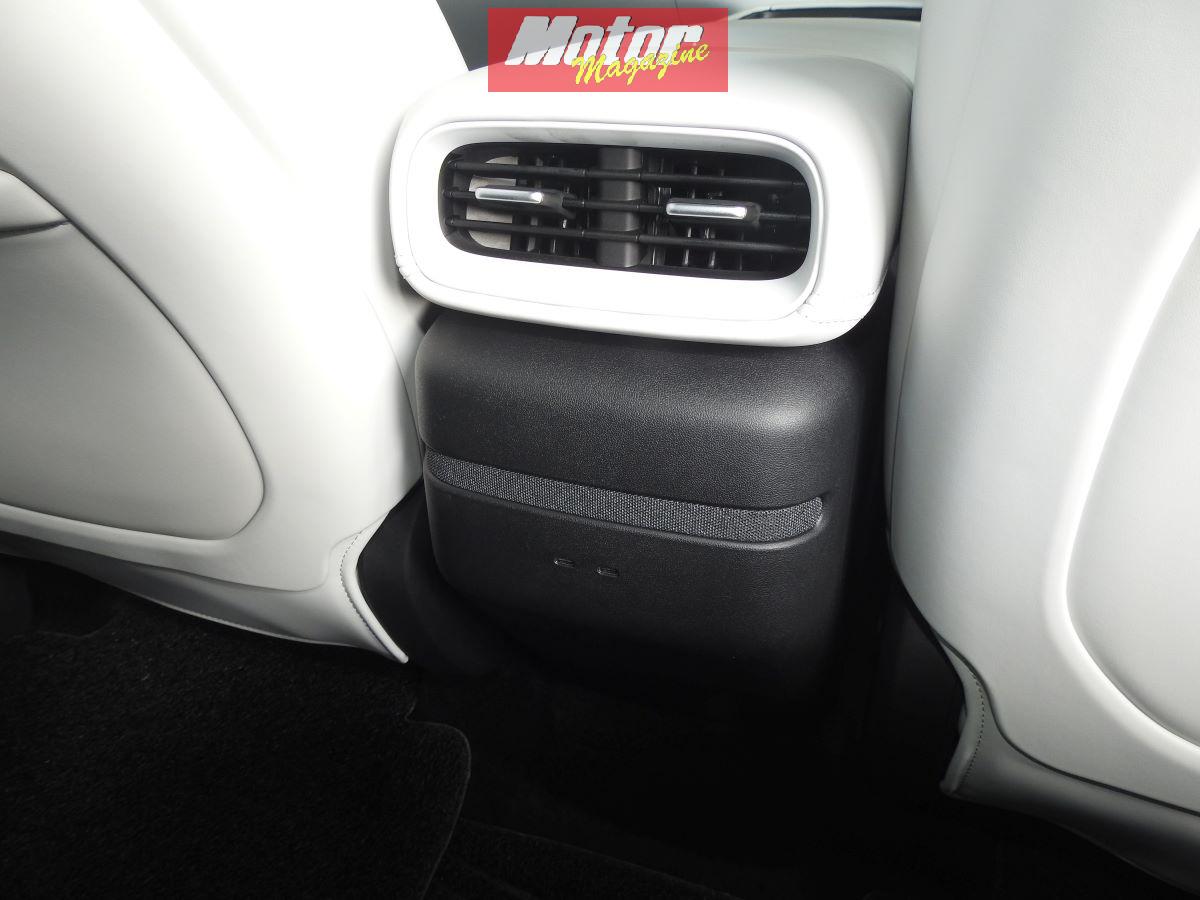
Regardless of interior choice, you get a comprehensive spec package. Both front seats have power adjustment, heating and ventilation capabilities. The rear seats also offer manual adjustment of their back rest angles for enhanced occupant comfort. There’s automatic dual-zone climate control with switchable rear vents, as well as an XfreeBreath intelligent air purification system with PM2.5 filtering. This feature automatically activated itself during our drive when we had kicked up some dust due to enthusiastic driving on a dusty road.
In terms of infotainment, the G6’s system is
controlled via a 14.96-inch touchscreen. It supports Apple CarPlay and Android Auto
and includes Bluetooth connectivity. It’s also got smart navigation, and
four-zone “Hey XPENG” voice recognition with intelligent recommendation. Specs
tell me that the system is underpinned by a Qualcomm Snapdragon 8155 chipset
and includes Wi-Fi and 4G network connectivity. There’s also a Welcome Mode and
a Meditation Mode. Meanwhile, the driver’s digital gauge cluster is a high
resolution 10.2-inch unit that worked superbly well.
Audiophiles will also like the G6’s XOPERA surround-sound system. The system comprises 18 speakers plus speakers in the driver’s seat and a trunk-mounted subwoofer. We see four of these speakers mounted in the roof as well. The door-mounted speakers use black cloth grilles that instantly appeal to me, as a fan of classic hi-fi equipment, as they precisely remind me of high-end Japanese speakers from the 1970s and 1980s. So how’s the sound quality? Well, very good. The ‘Flat’ setting, where all equalization and effects are turned off reveals a well-balanced soundscape with no hints of imbalance or distortion at higher volumes. If you want to customize things, there are several pre-set modes, as well as custom equalizer settings.
In-cabin storage is pretty decent, with a large centre
console storage bin and a capacious space beneath the centre console as well.
As for charging ports, you’ve got dual 50-watt wireless chargers up front, plus
front and rear USB and USB-C charging ports. The G6 also offers two 12-volt
power sockets, and has V2L (Vehicle-To-Load) power capabilities of up to 3.3
kilowatts at 220 volts AC. I was also pleased to see front cup-holders, a
feature that some modern cars seem to omit. Rear passengers get a duo of cup-holders
within their flip-down arm rest. As for unlocking the doors, that’s done via a
button. Press it and the door unlocks so that you can push it open. There’s an
emergency release in the door pockets as well.
What about cargo capacity? The specs tell me that the XPENG G6 has 571 litres of space with the rear seats in place. The rear seats have 60-40 split-folding functionality and with them fully folded, there’s a total of 1,374 litres of cargo capacity. I noted that the boot shape was pretty regular and the loading lip, although a little higher than expected, was suitably wide. The tailgate features fully electric operation too, and has a pretty decent obstacle sensor – I tested it with my arm, and it stopped almost immediately.
Safety and ADAS Features
The XPENG G6 comes with the XPILOT 2.5 safety suite,
that brings forward, side and rear collision prevention. Then, we’ve got
adaptive cruise control, a speed limiter, 12 ultrasonic sensors, 5
high-definition millimetre-wave radars, and a total of 12 cameras. There’s also
enhanced automatic park assist and remote parking assist. Some of the cameras
provide a high-resolution feed to the surround-view camera system display too.
The spec sheet informs me that an NVIDIA Orin-X processor controls the system.
You’ve also got the expected airbags, tire pressure monitor, ISOFIX mountings
for child seats in the rear, and an acoustic vehicle alerting system which is
the sound that EVs make at low speeds.
Range and Charging
Evolution Auto say that this variant of the XPENG G6
has a range of up to 435 kilometres. The battery can be charged from a
11-kilowatt 3-phase AC charger, or at a DC fast charging station. When using
the latter, the maximum charge rate is 215 kilowatts. This will yield a charge
speed of 10% to 80% in just 20 minutes, reportedly.
Price and Warranty
Evolution Auto sell the XPENG G6 at Rs. 27,000,000 all
inclusive. The higher price is due to the 190-kilowatt motor attracting a
notably greater tax component than most other EVs with their 100-kilowatt
motors. I’m told that Evolution Auto is looking into the possibility of getting
a lower powered variant at a cheaper price point for those who aren’t so
concerned with accelerative thrills. In terms of warranty, there’s 5 years for
the vehicle and 8 years for the battery pack.
Final Words
When I tested the XPENG G6 on the second day of the EV
Motor Show, I posted photos of my test drive on my social media. A close
contact who is well-known in luxury vehicle circles and is an ardent EV
proponent asked me for my thoughts, which I candidly gave. The next day I
learned that he had taken a test drive himself. When I asked him how he found
the G6, he replied, “Excellent. I think I’ll buy one”. And I think that sums up
the G6 and why Evolution Auto is bringing it down in this spec and price point.
It’s targeting the luxury segment rather than mainstream EV buyers, and in that
segment, attempting to woo clientele who have traditionally worshipped at the
altars of the key European luxury automakers. Granted, it’s a lofty ask, but
having tested the G6, I think it’s got the chops to capture those who are
suitably open-minded.